Foundations of quantum technologies · Girton College, Cambridge · 18th September 2026
Optimal Hamiltonian control for variational quantum algorithms
on spin-qubit quantum processors
Christopher K. Long1,2,3
1 University of Cambridge
2 Hitachi Cambridge Laboratory
3 Virginia Tech
Co-authors
Nicholas J. Mayhall3 , Sophia E. Economou3 , Edwin Barnes3 , Crispin H. W. Barnes1 , Frederico Martins2 , David R. M. Arvidsson-Shukur2 , Normann Mertig2
VQAs […] appear to be the best hope for obtaining quantum advantage.
M. Cerezo et al., Nature Reviews Physics
“Variational quantum algorithms” (Sept. 2021), pp. 625–644. issn: 2522-5820. doi: 10.1038/s42254-021-00348-9
Contents
01
Variational quantum eigensolver
Introduction & recap
02
Acceleration
Hamiltonian-level algorithms
03
Robustness
Leakage, dechorence, device imperfections
04
Scalability
Optimizability & Lie algebras
Contents 04
Headline result
105 ×
Faster & more noise robust
Improvement of our Hamiltonian-level approach over state-of-the-art gate-based approaches
Neglecting measurement time; measurement time is now the limiting factor for both speed and error rate.
Intro 05
Section 01
Variational quantum eigensolver
Introduction & recap: what is a variational quantum eigensolver?
Variational quantum eigensolver
Section 01 07A
Variational quantum eigensolver
|\psi(\theta)\rangle = U(\theta)|\psi_0\rangle
Section 01 07B
Variational quantum eigensolver
|\psi(\theta)\rangle = U(\theta)|\psi_0\rangle
E(\theta) = \langle\psi(\theta)|\hat{H}|\psi(\theta)\rangle
Section 01 07C
Variational quantum eigensolver
Section 01 08
Excessive runtimes
Single shot takes roughly 10–100 \mathrm{µs}
J. Tilly et al. , Phys. Rep. 986 , 1 (2022), doi:10.1016/j.physrep.2022.08.003 Section 01 09A
Excessive runtimes
Single shot takes roughly 10–100 \mathrm{µs} 2–20 hours per expectation value depending on accuracy you want
J. Tilly et al. , Phys. Rep. 986 , 1 (2022), doi:10.1016/j.physrep.2022.08.003 Section 01 09B
Excessive runtimes
Single shot takes roughly 10–100 \mathrm{µs} 2–20 hours per expectation value depending on accuracy you want 29–290 days per optimizer iteration
J. Tilly et al. , Phys. Rep. 986 , 1 (2022), doi:10.1016/j.physrep.2022.08.003 Section 01 09C
Excessive runtimes
Single shot takes roughly 10–100 \mathrm{µs} 2–20 hours per expectation value depending on accuracy you want 29–290 days per optimizer iteration Many years for whole algorithm to run
J. Tilly et al. , Phys. Rep. 986 , 1 (2022), doi:10.1016/j.physrep.2022.08.003 Section 01 09D
Excessive runtimes
Single shot takes roughly 10–100 \mathrm{µs} 2–20 hours per expectation value depending on accuracy you want 29–290 days per optimizer iteration Many years for whole algorithm to run Parellelization is not feasible in the near term
J. Tilly et al. , Phys. Rep. 986 , 1 (2022), doi:10.1016/j.physrep.2022.08.003 Section 01 09E
Excessive runtimes
Single shot takes roughly 10–100 \mathrm{µs} 2–20 hours per expectation value depending on accuracy you want 29–290 days per optimizer iteration Many years for whole algorithm to run Parellelization is not feasible in the near term Bring single shot time down to nanoseconds so iteration takes ~10 minutes
J. Tilly et al. , Phys. Rep. 986 , 1 (2022), doi:10.1016/j.physrep.2022.08.003 Section 01 09F
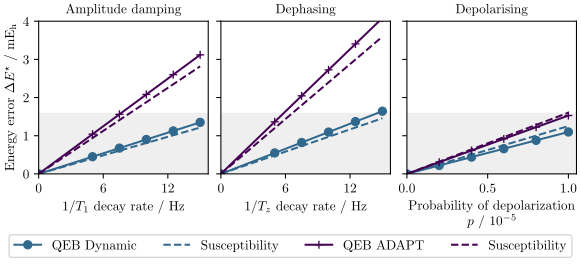
Decoherence
01
Amplitude damping
L=\sqrt{\frac{1}{T_1}}\,\sigma_-
02
Dephasing
L=\sqrt{\frac{1}{2T_2}}\,\sigma_z
03
Depolarizing
L_k=\frac{1}{2}\sqrt{p}\,\sigma_k,\ k\in\{x,y,z\}
Section 01 10
Decoherence
C. K. Long et al. , Phys. Rev. A 109 , 042413 (2024), doi:10.1103/PhysRevA.109.042413 Section 01 11A
H
H
H
H
Decoherence
C. K. Long et al. , Phys. Rev. A 109 , 042413 (2024), doi:10.1103/PhysRevA.109.042413 Section 01 11B
H
H
H
H
Requirements
T_1\ge 1\,\text{s} T_2\ge 100\,\text{ms} p\le10^{-6}
to reach chemical accuracy 1.6\,\mathrm{mE_{h}}
Section 02
Acceleration
Hamiltonian-level algorithms: are they faster?
Device
placeholder
x
z
y
C. K. Long et al. , npj Quantum Inf. 11 , 113 (2025), doi:10.1038/s41534-025-01027-8 Section 02 13A
Device
H(t) = -\frac{1}{2}\mu_B B_z \sum_{i=1}^{N} g_i \sigma_z^{(i)}
x
z
y
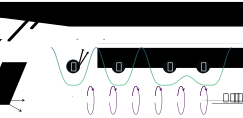
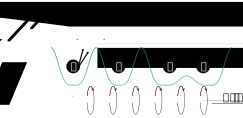
Zeeman Static field Bz sets each qubit’s splitting.
C. K. Long et al. , npj Quantum Inf. 11 , 113 (2025), doi:10.1038/s41534-025-01027-8 Section 02 13B
Device
H(t) = -\frac{1}{2}\mu_B B_z \sum_{i=1}^{N} g_i \sigma_z^{(i)} -\textcolor{#73407f}{\frac{1}{2}\mu_B B_x(t) \sum_{i=1}^{N} g_i \sigma_x^{(i)}}
x
z
y
Zeeman Static field Bz sets each qubit’s splitting.
Drive Antenna delivers the transverse control field Bx (t).
C. K. Long et al. , npj Quantum Inf. 11 , 113 (2025), doi:10.1038/s41534-025-01027-8 Section 02 13C
Device
H(t) = -\frac{1}{2}\mu_B B_z \sum_{i=1}^{N} g_i \sigma_z^{(i)} -\textcolor{#73407f}{\frac{1}{2}\mu_B B_x(t) \sum_{i=1}^{N} g_i \sigma_x^{(i)}} +\textcolor{#21918c}{\frac{1}{4}\sum_{i=1}^{N-1} J_i(t) \vec{\sigma}^{(i)} \cdot \vec{\sigma}^{(i+1)}}
x
z
y
Zeeman Static field Bz sets each qubit’s splitting.
Drive Antenna delivers the transverse control field Bx (t).
Exchange Gate voltages tune nearest-neighbour coupling Ji (t).
C. K. Long et al. , npj Quantum Inf. 11 , 113 (2025), doi:10.1038/s41534-025-01027-8 Section 02 13D
Device
H(t) = -\frac{1}{2}\mu_B B_z \sum_{i=1}^{N} g_i \sigma_z^{(i)} -\textcolor{#73407f}{\frac{1}{2}\mu_B B_x(t) \sum_{i=1}^{N} g_i \sigma_x^{(i)}} +\textcolor{#21918c}{\frac{1}{4}\sum_{i=1}^{N-1} J_i(t) \vec{\sigma}^{(i)} \cdot \vec{\sigma}^{(i+1)}}
Zeeman Static field Bz sets each qubit’s splitting.
Drive Antenna delivers the transverse control field Bx (t).
Exchange Gate voltages tune nearest-neighbour coupling Ji (t).
C. K. Long et al. , npj Quantum Inf. 11 , 113 (2025), doi:10.1038/s41534-025-01027-8 Section 02 13E
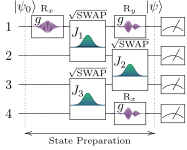
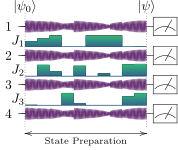
Gate-based computation
C. K. Long et al. , npj Quantum Inf. 11 , 113 (2025), doi:10.1038/s41534-025-01027-8 Section 02 14
Hamiltonian-level computation
C. K. Long et al. , npj Quantum Inf. 11 , 113 (2025), doi:10.1038/s41534-025-01027-8 Section 02 15
Molecule slide
C. K. Long et al. , npj Quantum Inf. 11 , 113 (2025), doi:10.1038/s41534-025-01027-8 Section 02 16
H
H
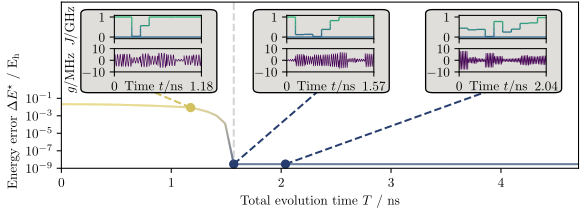
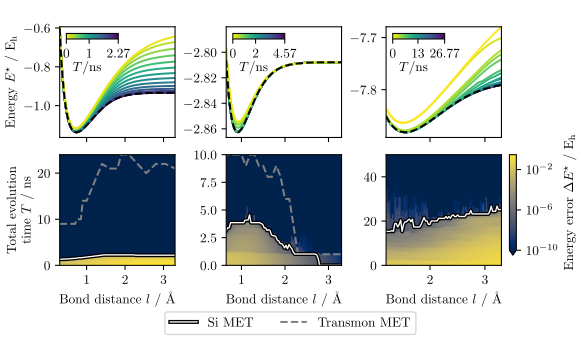
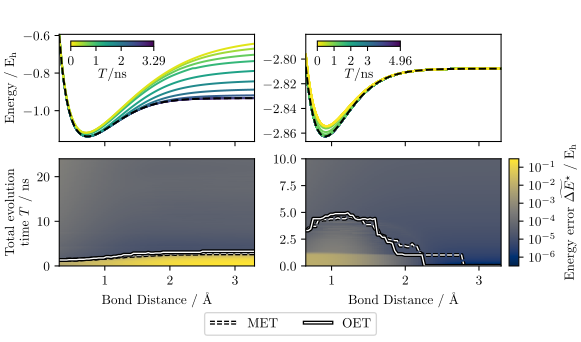
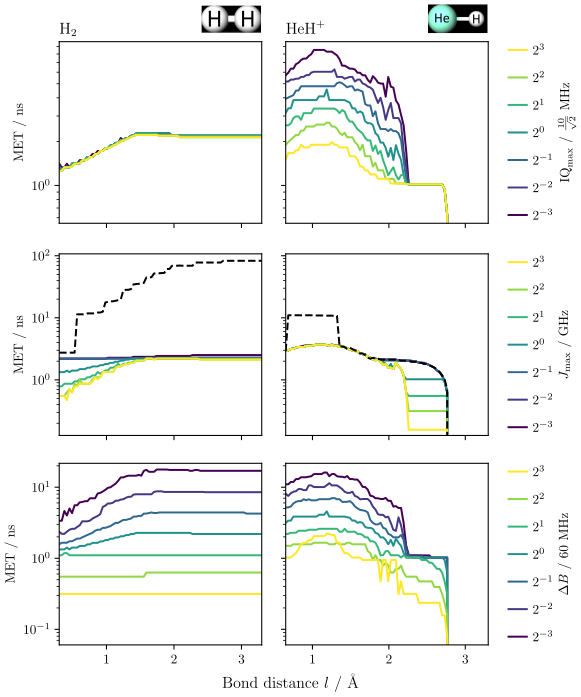
Minimum evolution times
C. K. Long et al. , npj Quantum Inf. 11 , 113 (2025), doi:10.1038/s41534-025-01027-8et al. , npj Quantum Inf. 7 , 155 (2021), doi:10.1038/s41534-021-00493-0 Section 02 17
H
H
He
H
+
Li
H
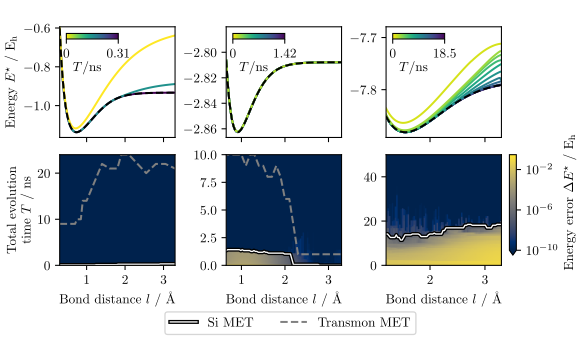
Virtual Z pulses
C. K. Long and C. H. W. Barnes, arXiv:2509.13453 (2025)et al. , npj Quantum Inf. 7 , 155 (2021), doi:10.1038/s41534-021-00493-0 Section 02 18
H
H
He
H
+
Li
H
Section 03
Robustness
Leakage, decoherence, device imperfections
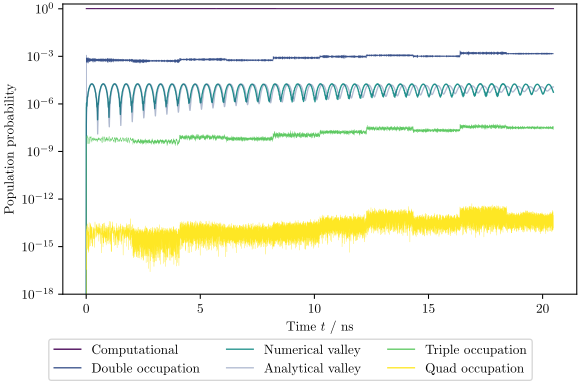
Leakage
Data
Valley hotspot
✗
Valley splitting / GHz
30.00
Relative energy error
0.013
Renormalized relative error
−0.00015
C. K. Long et al. , npj Quantum Inf. 11 , 113 (2025), doi:10.1038/s41534-025-01027-8 Section 03 20
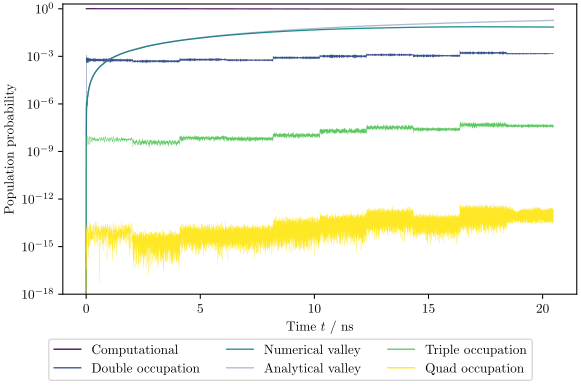
Leakage – valley hotspot
DATA
Valley hotspot
✗
✓
Valley splitting / GHz
30.00
28.03
Relative energy error
0.013
0.668
Renormalized relative error
−0.00015
−0.01225
C. K. Long et al. , npj Quantum Inf. 11 , 113 (2025), doi:10.1038/s41534-025-01027-8 Section 03 21
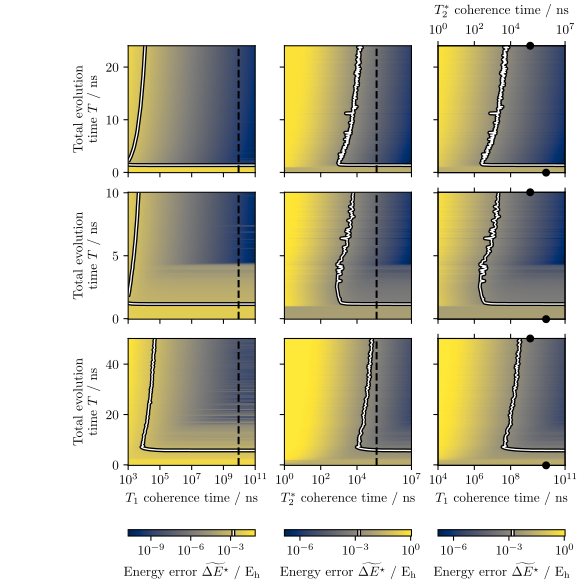
Decoherence
C. K. Long, PhD thesis, Univ. of Cambridge (2026), Ch. 4 Section 03 22
H
H
He
H
+
Li
H
Final column
T_1=10^4T_2
Chemical accuracy
1.6\,\mathrm{mE_h}
Decoherence
H
H
He
H
+
C. K. Long, PhD thesis, Univ. of Cambridge (2026), Ch. 4 Section 03 23
Section 04
Scalability
Optimizability & Lie algebras
Device
H(t) = -\frac{1}{2}\mu_B B_z \sum_{i=1}^{N} g_i \sigma_z^{(i)} -\textcolor{#73407f}{\frac{1}{2}\mu_B B_x(t) \sum_{i=1}^{N} g_i \sigma_x^{(i)}} +\textcolor{#21918c}{\frac{1}{4}\sum_{i=1}^{N-1} J_i(t) \vec{\sigma}^{(i)} \cdot \vec{\sigma}^{(i+1)}}
x
z
y
Zeeman Static field Bz sets each qubit’s splitting.
Drive Antenna delivers the transverse control field Bx (t).
Exchange Gate voltages tune nearest-neighbour coupling Ji (t).
C. K. Long, PhD thesis, Univ. of Cambridge (2026), Ch. 5 Section 04 25A
Device
\displaystyle H(t) = -\frac{1}{2}\mu_B B_z \sum_{i=1}^{N} g_i \sigma_z^{(i)} \displaystyle -\frac{1}{2}\mu_B B_x(t) \sum_{i=1}^{N} g_i \sigma_x^{(i)} \displaystyle +\frac{1}{4}\sum_{i=1}^{N-1} J_i(t) \vec{\sigma}^{(i)} \cdot \vec{\sigma}^{(i+1)}
x
z
y
Zeeman Static field Bz sets each qubit’s splitting.
Drive Antenna delivers the transverse control field Bx (t).
Exchange Gate voltages tune nearest-neighbour coupling Ji (t).
C. K. Long, PhD thesis, Univ. of Cambridge (2026), Ch. 5 Section 04 25B
Device dynamic Lie algebra
C. K. Long, PhD thesis, Univ. of Cambridge (2026), Ch. 5 Section 04 26A
\mathfrak{h_l}\coloneqq\left\langle\left\{i\sum_{i=1}^nB_iZ_i,\ i\vec\sigma_j\cdot\vec\sigma_{j+1}\right\}_{j=1}^{n-1}\right\rangle_{\text{Lie}}
Device dynamic Lie algebra
C. K. Long, PhD thesis, Univ. of Cambridge (2026), Ch. 5 Section 04 26B
\mathfrak{h_l}\coloneqq\left\langle\left\{i\sum_{i=1}^nB_iZ_i,\ i\vec\sigma_j\cdot\vec\sigma_{j+1}\right\}_{j=1}^{n-1}\right\rangle_{\text{Lie}}
Lie algebra
Example
Skew Hermitian matrices form \mathfrak{su}(n)
Device dynamic Lie algebra
C. K. Long, PhD thesis, Univ. of Cambridge (2026), Ch. 5 Section 04 26C
\mathfrak{h_l}\coloneqq\left\langle\left\{i\sum_{i=1}^nB_iZ_i,\ i\vec\sigma_j\cdot\vec\sigma_{j+1}\right\}_{j=1}^{n-1}\right\rangle_{\text{Lie}}
Lie algebra
Example
Skew Hermitian matrices form \mathfrak{su}(n)
Dynamic Lie algebra
The Lie algebra generated from each indepedently controllable term in the Hamiltonian
Device dynamic Lie algebra
C. K. Long, PhD thesis, Univ. of Cambridge (2026), Ch. 5 Section 04 26D
\mathfrak{h_l}\coloneqq\left\langle\left\{i\sum_{i=1}^nB_iZ_i,\ i\vec\sigma_j\cdot\vec\sigma_{j+1}\right\}_{j=1}^{n-1}\right\rangle_{\text{Lie}}
Lie algebra
Example
Skew Hermitian matrices form \mathfrak{su}(n)
Dynamic Lie algebra
The Lie algebra generated from each indepedently controllable term in the Hamiltonian Lie group
\exp:\mathfrak g\to G
Example
\operatorname{SU}(n)=\exp\mathfrak{su}(n)
Device dynamic Lie algebra
C. K. Long, PhD thesis, Univ. of Cambridge (2026), Ch. 5 Section 04 26E
\mathfrak{h_l}\coloneqq\left\langle\left\{i\sum_{i=1}^nB_iZ_i,\ i\vec\sigma_j\cdot\vec\sigma_{j+1}\right\}_{j=1}^{n-1}\right\rangle_{\text{Lie}} \mathfrak{h_l}\coloneqq\left\langle\left\{i\sum_{i=1}^nB_iZ_i,\ i\vec\sigma_j\cdot\vec\sigma_k\right\}_{1\le j<k\le n-1}\right\rangle_{\text{Lie}}
Lie algebra
Example
Skew Hermitian matrices form \mathfrak{su}(n)
Dynamic Lie algebra
The Lie algebra generated from each indepedently controllable term in the Hamiltonian Lie group
\exp:\mathfrak g\to G
Example
\operatorname{SU}(n)=\exp\mathfrak{su}(n)
Device dynamic Lie algebra
C. K. Long, PhD thesis, Univ. of Cambridge (2026), Ch. 5 Section 04 26F
\mathfrak{h_l}\coloneqq\left\langle\left\{i\sum_{i=1}^nB_iZ_i,\ i\vec\sigma_j\cdot\vec\sigma_k\right\}_{1\le j<k\le n-1}\right\rangle_{\text{Lie}}
Lie algebra
Example
Skew Hermitian matrices form \mathfrak{su}(n)
Dynamic Lie algebra
The Lie algebra generated from each indepedently controllable term in the Hamiltonian Lie group
\exp:\mathfrak g\to G
Example
\operatorname{SU}(n)=\exp\mathfrak{su}(n)
Commutators
C. K. Long, PhD thesis, Univ. of Cambridge (2026), Ch. 5 Section 04 27A
\mathfrak{h_l}\coloneqq\left\langle\left\{i\sum_{i=1}^nB_iZ_i,\ i\vec\sigma_j\cdot\vec\sigma_k\right\}_{1\le j<k\le n-1}\right\rangle_{\text{Lie}} \begin{aligned} \left[i\sum_{i=1}^nB_iZ_i,\ i\vec\sigma_j\cdot\vec\sigma_k\right] \end{aligned}
Lie algebra
Example
Skew Hermitian matrices form \mathfrak{su}(n)
Dynamic Lie algebra
The Lie algebra generated from each indepedently controllable term in the Hamiltonian Lie group
\exp:\mathfrak g\to G
Example
\operatorname{SU}(n)=\exp\mathfrak{su}(n)
Commutators
C. K. Long, PhD thesis, Univ. of Cambridge (2026), Ch. 5 Section 04 27B
\mathfrak{h_l}\coloneqq\left\langle\left\{i\sum_{i=1}^nB_iZ_i,\ i\vec\sigma_j\cdot\vec\sigma_k\right\}_{1\le j<k\le n-1}\right\rangle_{\text{Lie}} \begin{aligned} \left[i\sum_{i=1}^nB_iZ_i,\ i\vec\sigma_j\cdot\vec\sigma_k\right]&\propto i\frac{1}{2}(X_jY_k-Y_jX_k). \end{aligned}
Lie algebra
Example
Skew Hermitian matrices form \mathfrak{su}(n)
Dynamic Lie algebra
The Lie algebra generated from each indepedently controllable term in the Hamiltonian Lie group
\exp:\mathfrak g\to G
Example
\operatorname{SU}(n)=\exp\mathfrak{su}(n)
Commutators
C. K. Long, PhD thesis, Univ. of Cambridge (2026), Ch. 5 Section 04 27C
\mathfrak{h_l}\coloneqq\left\langle\left\{i\sum_{i=1}^nB_iZ_i,\ i\vec\sigma_j\cdot\vec\sigma_k\right\}_{1\le j<k\le n-1}\right\rangle_{\text{Lie}} \begin{aligned} \left[i\sum_{i=1}^nB_iZ_i,\ i\vec\sigma_j\cdot\vec\sigma_k\right]&\propto i\frac{1}{2}(X_jY_k-Y_jX_k),\\ \left[i\sum_{i=1}^nB_iZ_i,\ i(X_jY_k-Y_jX_k)\right] \end{aligned}
Lie algebra
Example
Skew Hermitian matrices form \mathfrak{su}(n)
Dynamic Lie algebra
The Lie algebra generated from each indepedently controllable term in the Hamiltonian Lie group
\exp:\mathfrak g\to G
Example
\operatorname{SU}(n)=\exp\mathfrak{su}(n)
Commutators
C. K. Long, PhD thesis, Univ. of Cambridge (2026), Ch. 5 Section 04 27D
\mathfrak{h_l}\coloneqq\left\langle\left\{i\sum_{i=1}^nB_iZ_i,\ i\vec\sigma_j\cdot\vec\sigma_k\right\}_{1\le j<k\le n-1}\right\rangle_{\text{Lie}} \begin{aligned} \left[i\sum_{i=1}^nB_iZ_i,\ i\vec\sigma_j\cdot\vec\sigma_k\right]&\propto i\frac{1}{2}(X_jY_k-Y_jX_k),\\ \left[i\sum_{i=1}^nB_iZ_i,\ i(X_jY_k-Y_jX_k)\right]&\propto i\frac{1}{2}(X_jX_k+Y_jY_k). \end{aligned}
Lie algebra
Example
Skew Hermitian matrices form \mathfrak{su}(n)
Dynamic Lie algebra
The Lie algebra generated from each indepedently controllable term in the Hamiltonian Lie group
\exp:\mathfrak g\to G
Example
\operatorname{SU}(n)=\exp\mathfrak{su}(n)
Commutators
C. K. Long, PhD thesis, Univ. of Cambridge (2026), Ch. 5 Section 04 27E
\mathfrak{h_l}\coloneqq\left\langle\left\{i\sum_{i=1}^nB_iZ_i,\ i\vec\sigma_j\cdot\vec\sigma_k\right\}_{1\le j<k\le n-1}\right\rangle_{\text{Lie}} \begin{aligned} \left[i\sum_{i=1}^nB_iZ_i,\ i\vec\sigma_j\cdot\vec\sigma_k\right]&\propto i\frac{1}{2}(X_jY_k-Y_jX_k),\\ \left[i\sum_{i=1}^nB_iZ_i,\ i(X_jY_k-Y_jX_k)\right]&\propto i\frac{1}{2}(X_jX_k+Y_jY_k),\\ \left[i(X_jX_k+Y_jY_k),\ i(X_jY_k-Y_jX_k)\right]& \end{aligned}
Lie algebra
Example
Skew Hermitian matrices form \mathfrak{su}(n)
Dynamic Lie algebra
The Lie algebra generated from each indepedently controllable term in the Hamiltonian Lie group
\exp:\mathfrak g\to G
Example
\operatorname{SU}(n)=\exp\mathfrak{su}(n)
Commutators
C. K. Long, PhD thesis, Univ. of Cambridge (2026), Ch. 5 Section 04 27F
\mathfrak{h_l}\coloneqq\left\langle\left\{i\sum_{i=1}^nB_iZ_i,\ i\vec\sigma_j\cdot\vec\sigma_k\right\}_{1\le j<k\le n-1}\right\rangle_{\text{Lie}} \begin{aligned} \left[i\sum_{i=1}^nB_iZ_i,\ i\vec\sigma_j\cdot\vec\sigma_k\right]&\propto i\frac{1}{2}(X_jY_k-Y_jX_k),\\ \left[i\sum_{i=1}^nB_iZ_i,\ i(X_jY_k-Y_jX_k)\right]&\propto i\frac{1}{2}(X_jX_k+Y_jY_k),\\ \left[i(X_jX_k+Y_jY_k),\ i(X_jY_k-Y_jX_k)\right]&\propto i\frac{1}{2}(Z_j-Z_k). \end{aligned}
Commutators
C. K. Long, PhD thesis, Univ. of Cambridge (2026), Ch. 5 Section 04 27G
\mathfrak{h_l}\coloneqq\left\langle\left\{i\sum_{i=1}^nB_iZ_i,\ i\vec\sigma_j\cdot\vec\sigma_k\right\}_{1\le j<k\le n-1}\right\rangle_{\text{Lie}} \begin{aligned} \left[i\sum_{i=1}^nB_iZ_i,\ i\vec\sigma_j\cdot\vec\sigma_k\right]&\propto i\frac{1}{2}(X_jY_k-Y_jX_k)=i\begin{bmatrix}0\\&0&-i\\&i&\phantom{-}0\\&&&0\end{bmatrix},\\ \left[i\sum_{i=1}^nB_iZ_i,\ i(X_jY_k-Y_jX_k)\right]&\propto i\frac{1}{2}(X_jX_k+Y_jY_k),\\ \left[i(X_jX_k+Y_jY_k),\ i(X_jY_k-Y_jX_k)\right]&\propto i\frac{1}{2}(Z_j-Z_k). \end{aligned}
Commutators
C. K. Long, PhD thesis, Univ. of Cambridge (2026), Ch. 5 Section 04 27H
\mathfrak{h_l}\coloneqq\left\langle\left\{i\sum_{i=1}^nB_iZ_i,\ i\vec\sigma_j\cdot\vec\sigma_k\right\}_{1\le j<k\le n-1}\right\rangle_{\text{Lie}} \begin{aligned} \left[i\sum_{i=1}^nB_iZ_i,\ i\vec\sigma_j\cdot\vec\sigma_k\right]&\propto i\frac{1}{2}(X_jY_k-Y_jX_k)=i\begin{bmatrix}0\\&0&-i\\&i&\phantom{-}0\\&&&0\end{bmatrix}\eqqcolon i\overline Y_{jk},\\ \left[i\sum_{i=1}^nB_iZ_i,\ i(X_jY_k-Y_jX_k)\right]&\propto i\frac{1}{2}(X_jX_k+Y_jY_k),\\ \left[i(X_jX_k+Y_jY_k),\ i(X_jY_k-Y_jX_k)\right]&\propto i\frac{1}{2}(Z_j-Z_k). \end{aligned}
Commutators
C. K. Long, PhD thesis, Univ. of Cambridge (2026), Ch. 5 Section 04 27I
\mathfrak{h_l}\coloneqq\left\langle\left\{i\sum_{i=1}^nB_iZ_i,\ i\vec\sigma_j\cdot\vec\sigma_k\right\}_{1\le j<k\le n-1}\right\rangle_{\text{Lie}} \begin{aligned} \left[i\sum_{i=1}^nB_iZ_i,\ i\vec\sigma_j\cdot\vec\sigma_k\right]&\propto i\frac{1}{2}(X_jY_k-Y_jX_k)=i\begin{bmatrix}0\\&0&-i\\&i&\phantom{-}0\\&&&0\end{bmatrix}\eqqcolon i\overline Y_{jk},\\ \left[i\sum_{i=1}^nB_iZ_i,\ i(X_jY_k-Y_jX_k)\right]&\propto i\frac{1}{2}(X_jX_k+Y_jY_k)=i\begin{bmatrix}0\\&0&\phantom{-}1\\&1&\phantom{-}0\\&&&0\end{bmatrix},\\ \left[i(X_jX_k+Y_jY_k),\ i(X_jY_k-Y_jX_k)\right]&\propto i\frac{1}{2}(Z_j-Z_k). \end{aligned}
Commutators
C. K. Long, PhD thesis, Univ. of Cambridge (2026), Ch. 5 Section 04 27J
\mathfrak{h_l}\coloneqq\left\langle\left\{i\sum_{i=1}^nB_iZ_i,\ i\vec\sigma_j\cdot\vec\sigma_k\right\}_{1\le j<k\le n-1}\right\rangle_{\text{Lie}} \begin{aligned} \left[i\sum_{i=1}^nB_iZ_i,\ i\vec\sigma_j\cdot\vec\sigma_k\right]&\propto i\frac{1}{2}(X_jY_k-Y_jX_k)=i\begin{bmatrix}0\\&0&-i\\&i&\phantom{-}0\\&&&0\end{bmatrix}\eqqcolon i\overline Y_{jk},\\ \left[i\sum_{i=1}^nB_iZ_i,\ i(X_jY_k-Y_jX_k)\right]&\propto i\frac{1}{2}(X_jX_k+Y_jY_k)=i\begin{bmatrix}0\\&0&\phantom{-}1\\&1&\phantom{-}0\\&&&0\end{bmatrix}\eqqcolon i\overline X_{jk},\\ \left[i(X_jX_k+Y_jY_k),\ i(X_jY_k-Y_jX_k)\right]&\propto i\frac{1}{2}(Z_j-Z_k). \end{aligned}
Commutators
C. K. Long, PhD thesis, Univ. of Cambridge (2026), Ch. 5 Section 04 27K
\mathfrak{h_l}\coloneqq\left\langle\left\{i\sum_{i=1}^nB_iZ_i,\ i\vec\sigma_j\cdot\vec\sigma_k\right\}_{1\le j<k\le n-1}\right\rangle_{\text{Lie}} \begin{aligned} \left[i\sum_{i=1}^nB_iZ_i,\ i\vec\sigma_j\cdot\vec\sigma_k\right]&\propto i\frac{1}{2}(X_jY_k-Y_jX_k)=i\begin{bmatrix}0\\&0&-i\\&i&\phantom{-}0\\&&&0\end{bmatrix}\eqqcolon i\overline Y_{jk},\\ \left[i\sum_{i=1}^nB_iZ_i,\ i(X_jY_k-Y_jX_k)\right]&\propto i\frac{1}{2}(X_jX_k+Y_jY_k)=i\begin{bmatrix}0\\&0&\phantom{-}1\\&1&\phantom{-}0\\&&&0\end{bmatrix}\eqqcolon i\overline X_{jk},\\ \left[i(X_jX_k+Y_jY_k),\ i(X_jY_k-Y_jX_k)\right]&\propto i\frac{1}{2}\mathrlap{(Z_j-Z_k)}\hphantom{(X_jX_k+Y_jY_k)}=i\begin{bmatrix}0\\&1\\&&-1\\&&&0\end{bmatrix}. \end{aligned}
Commutators
C. K. Long, PhD thesis, Univ. of Cambridge (2026), Ch. 5 Section 04 27L
\mathfrak{h_l}\coloneqq\left\langle\left\{i\sum_{i=1}^nB_iZ_i,\ i\vec\sigma_j\cdot\vec\sigma_k\right\}_{1\le j<k\le n-1}\right\rangle_{\text{Lie}} \begin{aligned} \left[i\sum_{i=1}^nB_iZ_i,\ i\vec\sigma_j\cdot\vec\sigma_k\right]&\propto i\frac{1}{2}(X_jY_k-Y_jX_k)=i\begin{bmatrix}0\\&0&-i\\&i&\phantom{-}0\\&&&0\end{bmatrix}\eqqcolon i\overline Y_{jk},\\ \left[i\sum_{i=1}^nB_iZ_i,\ i(X_jY_k-Y_jX_k)\right]&\propto i\frac{1}{2}(X_jX_k+Y_jY_k)=i\begin{bmatrix}0\\&0&\phantom{-}1\\&1&\phantom{-}0\\&&&0\end{bmatrix}\eqqcolon i\overline X_{jk},\\ \left[i(X_jX_k+Y_jY_k),\ i(X_jY_k-Y_jX_k)\right]&\propto i\frac{1}{2}\mathrlap{(Z_j-Z_k)}\hphantom{(X_jX_k+Y_jY_k)}=i\begin{bmatrix}0\\&1\\&&-1\\&&&0\end{bmatrix}\eqqcolon i\overline Z_{jk}. \end{aligned}
Device dynamic Lie algebra
C. K. Long, PhD thesis, Univ. of Cambridge (2026), Ch. 5 Section 04 28A
\mathfrak{h_l}=\left\langle\left\{i\sum_{i=1}^nZ_i,\ iZ_jZ_k,\ i\overline X_{jk},\ i\overline Y_{jk},\ i\overline Z_{jk}\right\}_{1\le j<k\le n-1}\right\rangle_{\text{Lie}}
Commutators
C. K. Long, PhD thesis, Univ. of Cambridge (2026), Ch. 5 Section 04 28B
\mathfrak{h_l}=\left\langle\left\{i\sum_{i=1}^nZ_i,\ iZ_jZ_k,\ i\overline X_{jk},\ i\overline Y_{jk},\ i\overline Z_{jk}\right\}_{1\le j<k\le n-1}\right\rangle_{\text{Lie}} \left[i\overline Y_{ij}I_k,\ iI_i\overline Y_{jk}\otimes\left\{I, Z\right\}^{\otimes n-3}\right]
Commutators
C. K. Long, PhD thesis, Univ. of Cambridge (2026), Ch. 5 Section 04 28C
\mathfrak{h_l}=\left\langle\left\{i\sum_{i=1}^nZ_i,\ iZ_jZ_k,\ i\overline X_{jk},\ i\overline Y_{jk},\ i\overline Z_{jk}\right\}_{1\le j<k\le n-1}\right\rangle_{\text{Lie}} \left[i\overline Y_{ij}I_k,\ iI_i\overline Y_{jk}\otimes\left\{I, Z\right\}^{\otimes n-3}\right]=\left[i\overline Y_{ij}I_k,\ iI_i\overline Y_{jk}\right]\otimes\left\{I, Z\right\}^{\otimes n-3}
Commutators
C. K. Long, PhD thesis, Univ. of Cambridge (2026), Ch. 5 Section 04 28D
\mathfrak{h_l}=\left\langle\left\{i\sum_{i=1}^nZ_i,\ iZ_jZ_k,\ i\overline X_{jk},\ i\overline Y_{jk},\ i\overline Z_{jk}\right\}_{1\le j<k\le n-1}\right\rangle_{\text{Lie}} \left[i\overline Y_{ij}I_k,\ iI_i\overline Y_{jk}\otimes\left\{I, Z\right\}^{\otimes n-3}\right]=\left[i\overline Y_{ij}I_k,\ iI_i\overline Y_{jk}\right]\otimes\left\{I, Z\right\}^{\otimes n-3}=i\overline Y_{ik} Z_j\otimes\left\{I, Z\right\}^{\otimes n-3}
Commutators
C. K. Long, PhD thesis, Univ. of Cambridge (2026), Ch. 5 Section 04 28E
\mathfrak{h_l}=\left\langle\left\{i\sum_{i=1}^nZ_i,\ iZ_jZ_k,\ i\overline X_{jk},\ i\overline Y_{jk},\ i\overline Z_{jk}\right\}_{1\le j<k\le n-1}\right\rangle_{\text{Lie}} \left[i\overline Y_{ij}I_k,\ iI_i\overline Y_{jk}\otimes\left\{I, Z\right\}^{\otimes n-3}\right]=\left[i\overline Y_{ij}I_k,\ iI_i\overline Y_{jk}\right]\otimes\left\{I, Z\right\}^{\otimes n-3}=i\overline Y_{ik} Z_j\otimes\left\{I, Z\right\}^{\otimes n-3} \left[i\overline X_{jk},\ i\overline Y_{jk}\otimes\left\{I, Z\right\}^{\otimes n-2}\right]=\left[i\overline X_{jk},\ i\overline Y_{jk}\right]\otimes\left\{I, Z\right\}^{\otimes n-2}=2i\overline Z_{jk}\otimes\left\{I, Z\right\}^{\otimes n-2}
Commutators
C. K. Long, PhD thesis, Univ. of Cambridge (2026), Ch. 5 Section 04 28F
\mathfrak{h_l}=\left\langle\left\{i\sum_{i=1}^nZ_i,\ iZ_jZ_k,\ i\overline X_{jk},\ i\overline Y_{jk},\ i\overline Z_{jk}\right\}_{1\le j<k\le n-1}\right\rangle_{\text{Lie}} \left[i\overline Y_{ij}I_k,\ iI_i\overline Y_{jk}\otimes\left\{I, Z\right\}^{\otimes n-3}\right]=\left[i\overline Y_{ij}I_k,\ iI_i\overline Y_{jk}\right]\otimes\left\{I, Z\right\}^{\otimes n-3}=i\overline Y_{ik} Z_j\otimes\left\{I, Z\right\}^{\otimes n-3} \left[i\overline X_{jk},\ i\overline Y_{jk}\otimes\left\{I, Z\right\}^{\otimes n-2}\right]=\left[i\overline X_{jk},\ i\overline Y_{jk}\right]\otimes\left\{I, Z\right\}^{\otimes n-2}=2i\overline Z_{jk}\otimes\left\{I, Z\right\}^{\otimes n-2} \left[i\overline Y_{jk},\ i\overline Z_{jk}\otimes\left\{I, Z\right\}^{\otimes n-2}\right]=\left[i\overline Y_{jk},\ i\overline Z_{jk}\right]\otimes\left\{I, Z\right\}^{\otimes n-2}=2i\overline X_{jk}\otimes\left\{I, Z\right\}^{\otimes n-2}
Device dynamic Lie algebra
C. K. Long, PhD thesis, Univ. of Cambridge (2026), Ch. 5 Section 04 29
\mathfrak{h_l}\!=\!\left\langle\!\left\{\!i\!\sum_{i=1}^nZ_i,i\!\!\!\!\sum_{\substack{l,m=1\colon\\l\ne m}}^n\!\!\!\!Z_lZ_m,i\overline X_{jk}\otimes\left\{\tfrac{1}{2}(I\!\pm \!Z)\right\}^{\otimes n-2},i\overline Y_{jk}\otimes\left\{\tfrac{1}{2}(I\!\pm \!Z)\right\}^{\otimes n-2},i\overline Z_{jk}\otimes\left\{\tfrac{1}{2}(I\!\pm \!Z)\right\}^{\otimes n-2}\right\}_{\substack{1\le j<k\\\le n-1}}\right\rangle_{\!\!\!\text{Lie}}
Gray code
C. K. Long, PhD thesis, Univ. of Cambridge (2026), Ch. 5 Section 04 30A
\begin{aligned} \ket{\begin{matrix} 0&1&0&0&1 \end{matrix}}\\ \phantom{\ket{\begin{matrix} 0&1&0&0&0 \end{matrix}}}\\ \phantom{\ket{\begin{matrix} 0&1&1&0&0 \end{matrix}}}\\ \phantom{\ket{\begin{matrix} 0&0&1&0&0 \end{matrix}}}\\ \ket{\begin{matrix} 1&0&1&0&0 \end{matrix}} \end{aligned}
Gray code
C. K. Long, PhD thesis, Univ. of Cambridge (2026), Ch. 5 Section 04 30B
\begin{aligned} \ket{\begin{matrix} 0&1&0&0&1 \end{matrix}}\\ \ket{\begin{matrix} 0&1&0&0&\textcolor{#21918c}{0} \end{matrix}}\\ \phantom{\ket{\begin{matrix} 0&1&1&0&0 \end{matrix}}}\\ \phantom{\ket{\begin{matrix} 0&0&1&0&0 \end{matrix}}}\\ \ket{\begin{matrix} 1&0&1&0&0 \end{matrix}} \end{aligned}
Gray code
C. K. Long, PhD thesis, Univ. of Cambridge (2026), Ch. 5 Section 04 30C
\begin{aligned} \ket{\begin{matrix} 0&1&0&0&1 \end{matrix}}\\ \ket{\begin{matrix} 0&1&0&0&0 \end{matrix}}\\ \ket{\begin{matrix} 0&1&\textcolor{#21918c}{1}&0&0 \end{matrix}}\\ \phantom{\ket{\begin{matrix} 0&0&1&0&0 \end{matrix}}}\\ \ket{\begin{matrix} 1&0&1&0&0 \end{matrix}} \end{aligned}
Gray code
C. K. Long, PhD thesis, Univ. of Cambridge (2026), Ch. 5 Section 04 30D
\begin{aligned} \ket{\begin{matrix} 0&1&0&0&1 \end{matrix}}\\ \ket{\begin{matrix} 0&1&0&0&0 \end{matrix}}\\ \ket{\begin{matrix} 0&1&1&0&0 \end{matrix}}\\ \ket{\begin{matrix} 0&\textcolor{#21918c}{0}&1&0&0 \end{matrix}}\\ \ket{\begin{matrix} 1&0&1&0&0 \end{matrix}} \end{aligned}
Gray-inspired code
C. K. Long, PhD thesis, Univ. of Cambridge (2026), Ch. 5 Section 04 31A
\begin{aligned} \ket{\begin{matrix} 0&1&0&0&1 \end{matrix}}\equiv \ket{\overline 0}\\ \phantom{\ket{\begin{matrix} 0&1&1&0&0 \end{matrix}}\equiv \ket{\overline 1}}\\ \ket{\begin{matrix} 1&0&1&0&0 \end{matrix}}\equiv \ket{\overline 2} \end{aligned}
Gray-inspired code
C. K. Long, PhD thesis, Univ. of Cambridge (2026), Ch. 5 Section 04 31B
\begin{aligned} \ket{\begin{matrix} 0&1&0&0&1 \end{matrix}}\equiv \ket{\overline 0}\\ \ket{\begin{matrix} 0&1&\textcolor{#21918c}{1}&0&\textcolor{#21918c}{0} \end{matrix}}\equiv \ket{\overline 1}\\ \ket{\begin{matrix} 1&0&1&0&0 \end{matrix}}\equiv \ket{\overline 2} \end{aligned}
Gray-inspired code
C. K. Long, PhD thesis, Univ. of Cambridge (2026), Ch. 5 Section 04 31C
\mathfrak{h_l}\!=\!\left\langle\!\left\{\!i\!\sum_{i=1}^nZ_i,i\!\!\!\!\sum_{\substack{l,m=1\colon\\l\ne m}}^n\!\!\!\!Z_lZ_m,i\overline X_{jk}\otimes\left\{\tfrac{1}{2}(I\!\pm \!Z)\right\}^{\otimes n-2},i\overline Y_{jk}\otimes\left\{\tfrac{1}{2}(I\!\pm \!Z)\right\}^{\otimes n-2},i\overline Z_{jk}\otimes\left\{\tfrac{1}{2}(I\!\pm \!Z)\right\}^{\otimes n-2}\right\}_{\substack{1\le j<k\\\le n-1}}\right\rangle_{\!\!\!\text{Lie}} \begin{aligned} \ket{\begin{matrix} 0&1&0&0&1 \end{matrix}}\equiv \ket{\overline 0}\\ \ket{\begin{matrix} 0&1&1&0&0 \end{matrix}}\equiv \ket{\overline 1}\\ \ket{\begin{matrix} 1&0&1&0&0 \end{matrix}}\equiv \ket{\overline 2} \end{aligned}
Gray-inspired code
C. K. Long, PhD thesis, Univ. of Cambridge (2026), Ch. 5 Section 04 31D
\mathfrak{h_l}\!=\!\left\langle\!\left\{\!i\!\sum_{i=1}^nZ_i,i\!\!\!\!\sum_{\substack{l,m=1\colon\\l\ne m}}^n\!\!\!\!Z_lZ_m,i\overline X_{jk}\otimes\left\{\tfrac{1}{2}(I\!\pm \!Z)\right\}^{\otimes n-2},i\overline Y_{jk}\otimes\left\{\tfrac{1}{2}(I\!\pm \!Z)\right\}^{\otimes n-2},i\overline Z_{jk}\otimes\left\{\tfrac{1}{2}(I\!\pm \!Z)\right\}^{\otimes n-2}\right\}_{\substack{1\le j<k\\\le n-1}}\right\rangle_{\!\!\!\text{Lie}} \begin{aligned} \ket{\begin{matrix} 0&1&0&0&1 \end{matrix}}\equiv \ket{\overline 0}\\ \ket{\begin{matrix} 0&1&1&0&0 \end{matrix}}\equiv \ket{\overline 1}\\ \ket{\begin{matrix} 1&0&1&0&0 \end{matrix}}\equiv \ket{\overline 2} \end{aligned}
\sum_{m=0}^ka_m\ket{\overline m}+\ket{\psi}
Gray-inspired code
C. K. Long, PhD thesis, Univ. of Cambridge (2026), Ch. 5 Section 04 31E
\mathfrak{h_l}\!=\!\left\langle\!\left\{\!i\!\sum_{i=1}^nZ_i,i\!\!\!\!\sum_{\substack{l,m=1\colon\\l\ne m}}^n\!\!\!\!Z_lZ_m,i\overline X_{jk}\otimes\left\{\tfrac{1}{2}(I\!\pm \!Z)\right\}^{\otimes n-2},i\overline Y_{jk}\otimes\left\{\tfrac{1}{2}(I\!\pm \!Z)\right\}^{\otimes n-2},i\overline Z_{jk}\otimes\left\{\tfrac{1}{2}(I\!\pm \!Z)\right\}^{\otimes n-2}\right\}_{\substack{1\le j<k\\\le n-1}}\right\rangle_{\!\!\!\text{Lie}} \begin{aligned} \ket{\begin{matrix} 0&1&0&0&1 \end{matrix}}\equiv \ket{\overline 0}\\ \ket{\begin{matrix} 0&1&1&0&0 \end{matrix}}\equiv \ket{\overline 1}\\ \ket{\begin{matrix} 1&0&1&0&0 \end{matrix}}\equiv \ket{\overline 2} \end{aligned}
\sum_{m=0}^ka_m\ket{\overline m}+\ket{\psi}
\ket{\overline m}\mapsto\ket{\overline{m+1}}\text{ and }\ket{\overline{m+1}}\mapsto-\ket{\overline m}
Gray-inspired code
C. K. Long, PhD thesis, Univ. of Cambridge (2026), Ch. 5 Section 04 31F
\mathfrak{h_l}\!=\!\left\langle\!\left\{\!i\!\sum_{i=1}^nZ_i,i\!\!\!\!\sum_{\substack{l,m=1\colon\\l\ne m}}^n\!\!\!\!Z_lZ_m,i\overline X_{jk}\otimes\left\{\tfrac{1}{2}(I\!\pm \!Z)\right\}^{\otimes n-2},i\overline Y_{jk}\otimes\left\{\tfrac{1}{2}(I\!\pm \!Z)\right\}^{\otimes n-2},i\overline Z_{jk}\otimes\left\{\tfrac{1}{2}(I\!\pm \!Z)\right\}^{\otimes n-2}\right\}_{\substack{1\le j<k\\\le n-1}}\right\rangle_{\!\!\!\text{Lie}} \begin{aligned} \ket{\begin{matrix} 0&1&0&0&1 \end{matrix}}\equiv \ket{\overline 0}\\ \ket{\begin{matrix} 0&1&1&0&0 \end{matrix}}\equiv \ket{\overline 1}\\ \ket{\begin{matrix} 1&0&1&0&0 \end{matrix}}\equiv \ket{\overline 2} \end{aligned}
\sum_{m=0}^ka_m\ket{\overline m}+\ket{\psi}\mapsto-\sum_{m=0}^{k-2}a_{m+1}\ket{\overline m}+a_0\ket{\overline{k-1}}+a_k\ket{\overline k}+\ket{\psi}
Gray-inspired code
C. K. Long, PhD thesis, Univ. of Cambridge (2026), Ch. 5 Section 04 31G
\mathfrak{h_l}\!=\!\left\langle\!\left\{\!i\!\sum_{i=1}^nZ_i,i\!\!\!\!\sum_{\substack{l,m=1\colon\\l\ne m}}^n\!\!\!\!Z_lZ_m,i\overline X_{jk}\otimes\left\{\tfrac{1}{2}(I\!\pm \!Z)\right\}^{\otimes n-2},i\overline Y_{jk}\otimes\left\{\tfrac{1}{2}(I\!\pm \!Z)\right\}^{\otimes n-2},i\overline Z_{jk}\otimes\left\{\tfrac{1}{2}(I\!\pm \!Z)\right\}^{\otimes n-2}\right\}_{\substack{1\le j<k\\\le n-1}}\right\rangle_{\!\!\!\text{Lie}} \begin{aligned} \ket{\begin{matrix} 0&1&0&0&1 \end{matrix}}\equiv \ket{\overline 0}\\ \ket{\begin{matrix} 0&1&1&0&0 \end{matrix}}\equiv \ket{\overline 1}\\ \ket{\begin{matrix} 1&0&1&0&0 \end{matrix}}\equiv \ket{\overline 2} \end{aligned}
\sum_{m=0}^ka_m\ket{\overline m}+\ket{\psi}\mapsto-\sum_{m=0}^{k-2}a_{m+1}\ket{\overline m}+\textcolor{#21918c}{a_0'}\ket{\overline{k-1}}+\textcolor{#21918c}{a_k'}\ket{\overline k}+\ket{\psi}
\begin{bmatrix} \textcolor{#21918c}{a_0'}\\ \textcolor{#21918c}{a_k'} \end{bmatrix}=U\begin{bmatrix} a_0\\ a_k \end{bmatrix}\qquad U\in \operatorname{SU}(2)
Gray-inspired code
C. K. Long, PhD thesis, Univ. of Cambridge (2026), Ch. 5 Section 04 31H
\mathfrak{h_l}\!=\!\left\langle\!\left\{\!i\!\sum_{i=1}^nZ_i,i\!\!\!\!\sum_{\substack{l,m=1\colon\\l\ne m}}^n\!\!\!\!Z_lZ_m,i\overline X_{jk}\otimes\left\{\tfrac{1}{2}(I\!\pm \!Z)\right\}^{\otimes n-2},i\overline Y_{jk}\otimes\left\{\tfrac{1}{2}(I\!\pm \!Z)\right\}^{\otimes n-2},i\overline Z_{jk}\otimes\left\{\tfrac{1}{2}(I\!\pm \!Z)\right\}^{\otimes n-2}\right\}_{\substack{1\le j<k\\\le n-1}}\right\rangle_{\!\!\!\text{Lie}} \begin{aligned} \ket{\begin{matrix} 0&1&0&0&1 \end{matrix}}\equiv \ket{\overline 0}\\ \ket{\begin{matrix} 0&1&1&0&0 \end{matrix}}\equiv \ket{\overline 1}\\ \ket{\begin{matrix} 1&0&1&0&0 \end{matrix}}\equiv \ket{\overline 2} \end{aligned}
\sum_{m=0}^ka_m\ket{\overline m}+\ket{\psi}\mapsto\sum_{m=1}^{k-1}a_m\ket{\overline m}+a_0'\ket{\overline{0}}+a_k'\ket{\overline k}+\ket{\psi}
\ket{\overline m}\mapsfrom\ket{\overline{m+1}}\text{ and }\ket{\overline{m+1}}\mapsfrom-\ket{\overline m}
Device dynamic Lie algebra
C. K. Long, PhD thesis, Univ. of Cambridge (2026), Ch. 5 Section 04 32
\mathfrak{h_l}=\left\langle\left\{i\sum_{i=1}^nZ_i,\ i\sum_{\substack{l,m=1\colon\\l\ne m}}^nZ_lZ_m\right\}\cup\bigoplus_{N_{\text{e}}=0}^n\mathfrak{su}\!\left[\binom{n}{N_{\text{e}}}\right]\right\rangle_{\text{Lie}}
Centralizer
C. K. Long, PhD thesis, Univ. of Cambridge (2026), Ch. 5 Section 04 33
\mathfrak{h_l}=\left\langle\left\{i\sum_{i=1}^nZ_i,\ i\sum_{\substack{l,m=1\colon\\l\ne m}}^nZ_lZ_m\right\}\cup\bigoplus_{N_{\text{e}}=0}^n\mathfrak{su}\!\left[\binom{n}{N_{\text{e}}}\right]\right\rangle_{\text{Lie}} i\sum_{\substack{j,k=1\colon\\j\ne k}}^nZ_jZ_k=i\left(\sum_{i=1}^nZ_i\right)^2-inI
Device dynamic Lie algebra
C. K. Long, PhD thesis, Univ. of Cambridge (2026), Ch. 5 Section 04 34
\mathfrak{h_l}=\mathfrak{u}(1)^{\oplus 2}\oplus\textcolor{#21918c}{\bigoplus_{N_{\text{e}}=0}^n\mathfrak{su}\!\left[\binom{n}{N_{\text{e}}}\right]}
Qubit-excitation dynamic Lie algebra
C. K. Long, PhD thesis, Univ. of Cambridge (2026), Ch. 5 Section 04 35
\mathfrak{h_l}=\mathfrak{u}(1)^{\oplus 2}\oplus\textcolor{#21918c}{\bigoplus_{N_{\text{e}}=0}^n\mathfrak{su}\!\left[\binom{n}{N_{\text{e}}}\right]}
\mathfrak{q}=\bigoplus_{N_{\text{e}}=0}^n\mathfrak{o}\!\left[\binom{n}{N_{\text{e}}}\right]
Barren plateaus
M. Ragone et al. , Nat Commun 15 , 7172 (2024), doi:10.1038/s41467-024-49909-3 Section 04 36A
\mathfrak{h_l}=\mathfrak{u}(1)^{\oplus 2}\oplus\textcolor{#21918c}{\bigoplus_{N_{\text{e}}=0}^n\mathfrak{su}\!\left[\binom{n}{N_{\text{e}}}\right]}
\mathfrak{q}=\bigoplus_{N_{\text{e}}=0}^n\mathfrak{o}\!\left[\binom{n}{N_{\text{e}}}\right]
Theorem (Ragone et al. informal)
If
The dynamic Lie algebra is \mathfrak g=\bigoplus_{i}\mathfrak g_i , The initial state is in \mathfrak g_i , The ansatz is sufficiently deep, then
\operatorname{Var}_{\vec\theta}E(\vec\theta)\propto\frac{1}{\dim\mathfrak{g}_i}
Barren plateaus
C. K. Long, PhD thesis, Univ. of Cambridge (2026), Ch. 5 Section 04 36B
\mathfrak{h_l}=\mathfrak{u}(1)^{\oplus 2}\oplus\textcolor{#21918c}{\bigoplus_{N_{\text{e}}=0}^n\mathfrak{su}\!\left[\binom{n}{N_{\text{e}}}\right]}
\mathfrak{q}=\bigoplus_{N_{\text{e}}=0}^n\mathfrak{o}\!\left[\binom{n}{N_{\text{e}}}\right]
Theorem (Ragone et al. informal)
If
The dynamic Lie algebra is \mathfrak g=\bigoplus_{i}\mathfrak g_i , The initial state is in \mathfrak g_i , The ansatz is sufficiently deep, then
\operatorname{Var}_{\vec\theta}E(\vec\theta)\propto\frac{1}{\dim\mathfrak{g}_i} \operatorname{Var}_{\vec\theta}E(\vec\theta)\propto\frac{1}{f_{\mathfrak g_i}(\dim\mathfrak{g}_i)}
Barren plateaus
C. K. Long, PhD thesis, Univ. of Cambridge (2026), Ch. 5 Section 04 36C
\mathfrak{h_l}=\mathfrak{u}(1)^{\oplus 2}\oplus\textcolor{#21918c}{\bigoplus_{N_{\text{e}}=0}^n\mathfrak{su}\!\left[\binom{n}{N_{\text{e}}}\right]}
\mathfrak{q}=\bigoplus_{N_{\text{e}}=0}^n\mathfrak{o}\!\left[\binom{n}{N_{\text{e}}}\right]
\frac{\operatorname{Var}^{\mathfrak{q}}_{\vec\theta}E(\vec\theta)}{\operatorname{Var}^{\mathfrak{h}}_{\vec\theta}E(\vec\theta)}\sim2
Comparison table
Method
Shot acceleration
Noise robustness
Landscape variance
Gate-based VQE
1
1
1
Hardware efficient
10^2\text{--}10^{3} \sim\!10^2\text{--}10^{3} \exp(-n)
Hamiltonian-level VQE
10^4\text{--}10^{5} 10^4\text{--}10^{5} 0.5
+ Virtual Z pulses
slightly faster
slightly larger
0.5
Hybrid gate–Hamiltonian
10^{2} \sim\!10^{2} 1
~ indicates the value is estimated based on the other trends
Summary 37
Concrete values
Method
Shot time / \mathrm{ns}
Required T_2 / \mathrm{µs}
Landscape variance
Gate-based VQE
10^4\text{--}10^{5} 10^{5} \propto\frac{1}{\frac{1}{2}\binom{n}{N_{\mathrm{e}}}+1}
Hardware efficient
10^{2} \sim\!10^{2} \propto\frac{1}{2^n+1}
Hamiltonian-level VQE
2\text{--}27 1\text{--}10 \propto\frac{1}{\binom{n}{N_{\mathrm{e}}}+1}
+ Virtual Z pulses
0.3\text{--}19 \sim\!0.1\text{--}10 \propto\frac{1}{\binom{n}{N_{\mathrm{e}}}+1}
Hybrid gate–Hamiltonian
10\text{--}10^2 \sim\!10\text{--}10^2 \propto\frac{1}{\frac{1}{2}\binom{n}{N_{\mathrm{e}}}+1}
~ indicates the value is estimated based on the other trends
Summary 38
Summary
01
Hamiltonian-level algorithms can be up to 10^{5} times faster than gate-based algorithms
02
Hamiltonian-level algorithms are more robust to decoherence, leakage, and device imperfections than gate-based algorithms
03
Hamiltonian-level algorithms can be designed to scale at a penalty to runtime.
Summary 39
Acknowledgements
Supervisors
Crispin H. W. Barnes
Collaborators
Nicholas J. Mayhall
DISCUSSIONS
Henrik Gothen
Slides made with Claude Design Acknowledgements 40
Availability
ARTICLES
C. K. Long. PhD thesis, Univ. of Cambridge (2026) K. Dalton, et al. npj Quantum Inf 10 , 18 (2024). doi:10.1038/s41534-024-00808-x C. K. Long, et al. Phys. Rev. A 109 , 042413 (2024). doi:10.1103/PhysRevA.109.042413 C.K. Long, et al. npj Quantum Inf 11 , 113 (2025). doi:10.1038/s41534-025-01027-8 C. K. Long & C. H. W. Barnes. arXiv:2509.13453 (2025) Gothen, H., et al. arXiv:2606.17357 (2026)
SOFTWARE
github.com/Christopher-K-Long/Minimal-state-preparation-times-for-silicon-spin-qubits-source-code Suzuki-Trotter-Evolver.readthedocs.io PySTE.readthedocs.io QuGrad.readthedocs.io QuGradLab.readthedocs.io
DATA
doi:10.5281/zenodo.15676408
Acknowledgements 41
Thank you
Hamiltonian-level VQAs are up to 10^{5} times faster and more robust
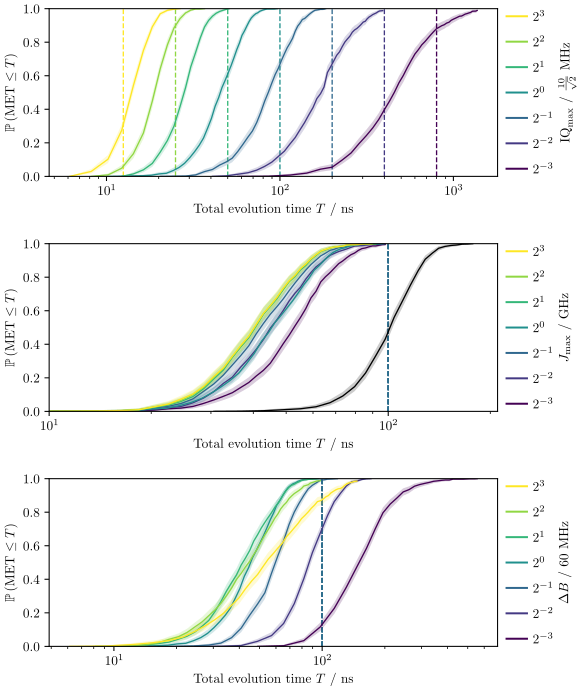
C. K. Long et al. , npj Quantum Inf. 11 , 113 (2025), doi:10.1038/s41534-025-01027-8 Backup B1
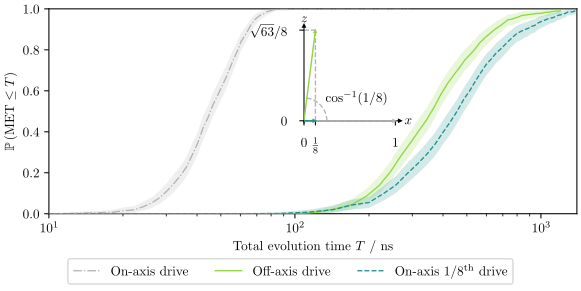
C. K. Long et al. , npj Quantum Inf. 11 , 113 (2025), doi:10.1038/s41534-025-01027-8 Backup B2
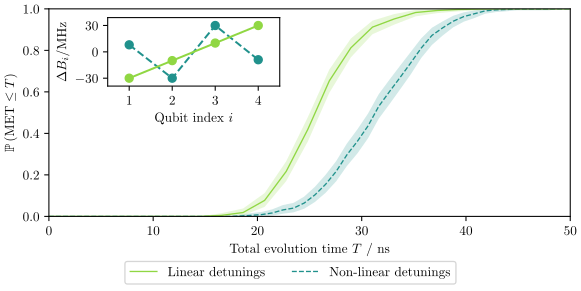
C. K. Long et al. , npj Quantum Inf. 11 , 113 (2025), doi:10.1038/s41534-025-01027-8 Backup B3
C. K. Long et al. , npj Quantum Inf. 11 , 113 (2025), doi:10.1038/s41534-025-01027-8 Backup B4